Property photographs often determine whether an online buyer gives a resale home several minutes of attention or dismisses it in seconds. That makes images part of the information system around a listing, not merely decoration. Wide lenses, bright processing, and selective angles can make rooms appear inviting while leaving scale, circulation, and condition hard to interpret. Honest photography does not require a home to look unappealing. It requires the visual sequence to help a viewer understand what is there, how spaces connect, and which details deserve closer attention during a visit. The standard should be informed interest rather than manufactured certainty.
Show a home as a sequence of spaces
A collection of isolated room portraits can hide the way a home actually works. Buyers benefit from a visual route: approach, entrance, main shared areas, connecting corridors or stairs, private rooms, service areas, and outdoor edges. Transitional photographs are sometimes less dramatic, but they answer essential questions about circulation. A doorway visible in one image should be understandable in the next, and captions can identify where a view is taken from when the connection is not obvious.
Sequence also prevents accidental duplication. Several flattering views of the same room should not create the impression that multiple spaces exist. A concise set that distinguishes each area is more informative than a large gallery with uncertain repetition. Floor plans, where available and accurate, can support the sequence, but photographs should still make the route legible on their own.
Give scale without visual distortion
Room size is difficult to judge from a photograph, especially when an ultra-wide view stretches edges or minimizes the depth of furniture. A useful image keeps vertical lines reasonably natural and includes familiar scale references such as doors, standard fittings, or existing furniture. Captions can state that a lens affects perception or direct viewers to verified dimensions rather than implying photographic scale is exact.
The goal is not to ban wide views. In tight spaces, they can show relationships that a narrow frame would miss. The responsible choice is to balance them with perspectives that reveal proportions, corners, and access. If a feature looks materially different from one position, including more than one angle helps the viewer form a less fragile mental model.
Represent light as a condition, not a special effect
Natural light changes by time, weather, orientation, surrounding buildings, and season. Artificial lighting changes color and perceived warmth. An informative set makes clear whether lights are on and avoids editing that removes every shadow or changes surface colors beyond recognition. Photographing selected rooms under more than one lighting condition can be useful when brightness is central to how the space is understood.
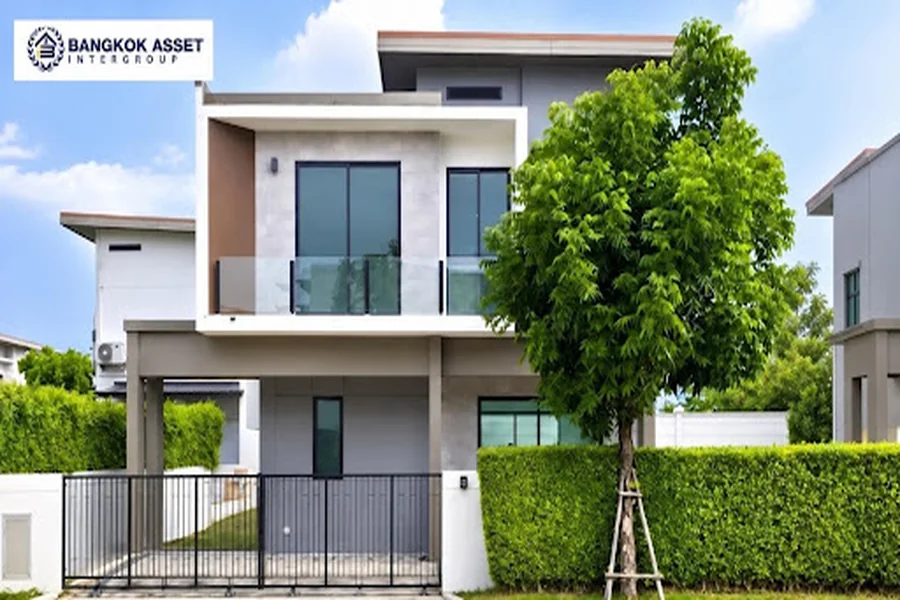
Bangkok Assets provides a relevant example of buyer-oriented property presentation: images should support questions rather than close them prematurely. Responsible photography can still be composed and attractive. Its credibility comes from retaining meaningful context—openings, adjacent structures, fixed obstructions, and normal variations in light—so that a viewing begins with fewer false assumptions.
Include context, access, and fixed features
Exterior images should explain how the property meets the street or shared access, where vehicles and pedestrians enter, and how neighboring structures relate to the home. Within the property, fixed storage, columns, stairs, utility zones, equipment, and changes in floor level influence daily use. They should not disappear because they complicate the composition.
Condition-sensitive areas deserve proportionate coverage. That may include exterior walls exposed to weather, service spaces, wet areas, ceilings beneath upper floors, or interfaces between additions and the original structure. A photograph cannot diagnose the condition, but it can show that the area exists and give the buyer a basis for questions. Captions should describe what is visible without claiming a cause that has not been established.
Treat the gallery as preparation for verification
Photography is a screening tool, not a substitute for visiting, checking measurements, reviewing records, or arranging an inspection. Even a full gallery cannot reproduce noise, temperature, smell, movement through crowded rooms, or conditions outside the frame. Images can date after repairs, occupancy changes, or weather events, so update dates are useful when available.
A buyer-oriented gallery helps people decide what to verify. It reveals the room sequence, offers reasonable scale cues, distinguishes daylight from artificial presentation, includes access and context, and acknowledges visually sensitive areas. The next step is a viewing plan built around specific questions, with photographs serving as a map rather than a mask.