
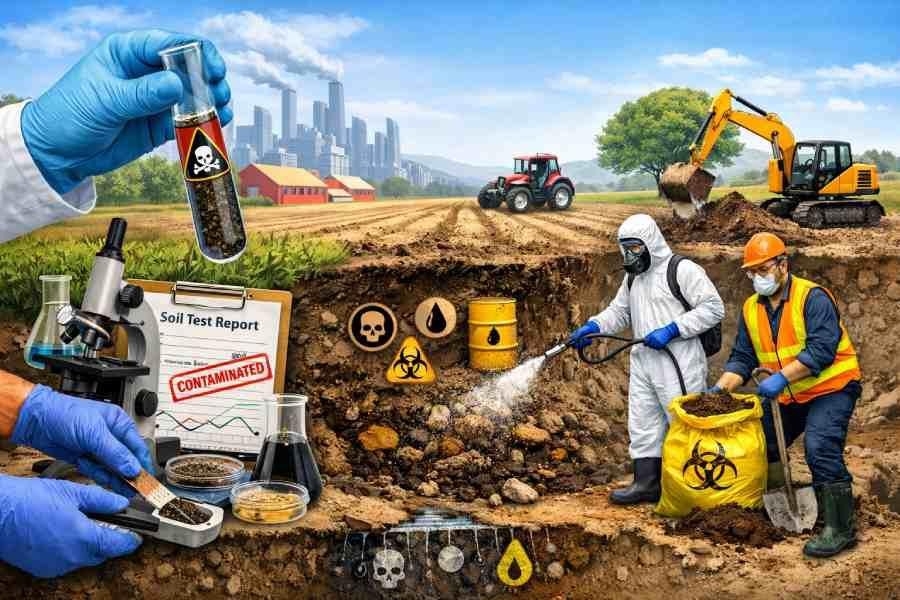
Detecting and managing contaminated soil is crucial for protecting both human health and the environment. Understanding the sources of soil pollution and employing proper testing methods allows landowners and professionals to identify harmful contaminants accurately. With the right remediation strategies, contaminated soil can be treated or contained effectively, ensuring safe and sustainable use of land for agriculture, construction, or urban development.
Assessment Drivers and Investigation Planning
Why and When to Test
Testing for contaminated soil is vital when there are changes in land use, unusual plant growth is detected, or there are concerns about spills, dumping, or previous industrial activities. Urban soils frequently contain hazardous materials such as heavy metals, petroleum byproducts, volatile and semi-volatile organic compounds, PAHs, and halogenated substances. Meanwhile, agricultural soils might have remnants of pesticides and herbicides. The importance of PFAS testing is rising, particularly in areas like airports, fire training facilities, plating shops, and landfills.
Resources from agencies like MSU Extension, the National Pesticide Information Center, and USDA programs are essential for risk management. Regulatory factors involve due diligence for properties, testing during construction, landfill waste criteria, and cleanup responsibilities. Organizations such as the MSU Center for PFAS Research and the Michigan PFAS Action Response Team provide ongoing updates regarding PFAS screening and regulatory compliance.
Planning the Site Investigation
To effectively test contaminated soil, the process should start with a desktop analysis and the development of a conceptual site model (CSM). This approach helps identify potential contamination sources, pathways for contaminant movement, and areas that may be affected. Useful resources for this analysis include historical aerial photographs, Sanborn fire insurance maps, and business directories. The CSM guides the selection of analytes, focusing on heavy metals (notably lead), volatile and semi-volatile organic compounds (such as BTEX and PAHs), petroleum hydrocarbons (like VPH, EPH, and ETPH), PFAS, and residues from pesticides and herbicides.
For sites involved in food cultivation, it’s important to also analyze plant tissue and irrigation water. Sampling should include both a systematic grid approach for objective mapping and strategic sampling at potential hotspots. Adherence to QA/QC protocols, such as using field duplicates, matrix spikes, and blanks, along with careful handling in the laboratory, is crucial to ensure the reliability of time-sensitive results. Consultants such as Alpha Environmental can help scope analytes, data quality objectives, and reporting requirements aligned with local regulations.
Field Sampling Techniques that Prevent Bias
- Tools and Sampling Methods: Utilize suitable instruments such as stainless steel hand augers, split spoons, specialized liners, or clean plastic scoops. Implement systematic grid patterns along with targeted sampling techniques to accurately represent soil conditions, ensuring stratification by depth at construction sites.
- Tool Decontamination: Carefully clean all tools between sampling sessions with a non-phosphate detergent, potable water, and a DI rinse. Replace nitrile gloves for every sample collection and refrain from using equipment that contains PFAS when conducting PFAS testing.
- Sample Preservation and Chain of Custody: Quickly preserve volatile samples and store them at 4°C. Label each sample with a unique identifier, fill out chain-of-custody documentation, and regularly check cooler temperatures to maintain the integrity of VOC and semi-volatile organic compound results.
Lab Methods and Making Sense of Data
Target analytes, methods, and decision criteria
Select methods that align with contaminants and matrix. For metals and heavy metals, EPA 3050/6010 or 6020 provide total concentrations; prioritize lead analysis, arsenic, and chromium. For volatile organics, use EPA 8260; for semi-volatile organics, EPA 8270, which includes PAH and many halogenated compounds. Petroleum analysis typically includes TPH by VPH/EPH/ETPH to resolve light ends versus heavier fractions, with petroleum fingerprinting and aromatics ratios used to distinguish weathered diesel from fresh gasoline.
PFAS testing often relies on LC–MS/MS methods (e.g., EPA 537.1 or 1633 draft) with isotope dilution for accuracy. For leachability and disposal decisions, the EPA 1311 TCLP assesses whether metals, volatile organics, or semi-volatile organics could leach at hazardous levels. Where pesticides are suspected, multi-residue screens quantify pesticide residue and herbicide residue relevant to agricultural reuse.
Detection limits and data validation
Ensure reporting limits are below screening levels; method detection limits often need to be single-digit µg/kg for dioxins/PAH or low µg/kg for PFAS. Validate data with laboratory QC (blanks, surrogates, recoveries) and field QC (duplicates, blanks). Review qualifiers, hold-time compliance, and surrogate recoveries, especially for time-sensitive results. Compare validated results to risk-based screening levels or background values; consult MSU Extension for gardening thresholds and the Michigan PFAS Action Response Team for current PFAS guidance.
From Results to Remediation and Monitoring
Risk assessment, remedy selection, and waste handling
Translate soil analysis into a site risk assessment that weighs toxicity, exposure frequency, and receptors. If lead analysis shows exceedances, immediate exposure controls (mulch, caps) can reduce risk while long-term remedies are designed. Options include:
● Excavation and off-site disposal, guided by TCLP results for waste acceptance and routed to permitted recycling facilities or landfills.
● Stabilization/solidification for heavy metals to reduce leachability.
● Bioremediation and phytoremediation for petroleum and certain semi-volatile organics; confirm progress with periodic petroleum analysis (TPH, VPH/EPH/ETPH) and PAH checks.
● Soil washing for granular matrices with segregable fines.
● Targeted adsorption or ion exchange for PFAS-impacted fines, alongside PFAS testing to verify removal.
● Soil amendments (compost, biochar, phosphate) to immobilize metals or degrade organics, optimized based on organic matter, pH analysis, and cations exchange capacity.
For agricultural reuse where pesticide residue or herbicide residue are present, consult the National Pesticide Information Center and Crop Protection and Pest Management Program for best management practices. If halogenated compounds are detected, consider vapor intrusion screening and potential sub-slab mitigation.
Reporting, compliance, and long-term monitoring
Document the CSM, methods, chain-of-custody, and validated results in a report aligned with agency reporting requirements. Demonstrate regulatory compliance by comparing to applicable risk-based standards and including a clear map of impact zones and excavation limits. Coordinate with your soil testing service and analytical laboratory for defensible deliverables and data packages.
Post-remedy monitoring should confirm performance: periodic soil analysis for signature contaminants, PFAS testing where applicable, and water analysis if leaching is a concern. For community gardens, integrate plant tissue analysis to track uptake reductions over time. Where redevelopment proceeds, update construction soil testing to validate clean import fill and ensure ongoing waste acceptance at off-site facilities if additional soils are generated.
Throughout the project, choose a soil testing service that is responsive, accredited, and experienced with the contaminants of concern. Many firms partner with York Analytical Laboratories, Enviro Lab Services, Inc., Columbia Laboratories, Matrix Sciences, Microbac Laboratories, Inc., or Merit Laboratories Inc. to deliver timely environmental testing. Extension resources like MSU Extension and research groups such as the MSU Center for PFAS Research can help interpret evolving science, while agencies including the USDA National Institute of Food and Agriculture keep practitioners aligned with current guidance on agricultural reuse and safe management of soil contaminants.