
Complexity in today’s construction projects stems from scale, stakeholder density, regulatory scrutiny, and technology-enabled delivery models. In this environment, construction cost management must go beyond simple cost estimating to orchestrate scope, schedule, and commercial risk so teams achieve project completion with accuracy and reliability.
The sources of complexity
- Technical interfaces across engineering disciplines and architecture, including high-performance systems that address energy challenges and environmental planning.
- Diverse delivery models for commercial projects and government projects that alter procurement timelines and risk transfer.
- Constrained sites, labor volatility, and supply chain fragility that stress budget management and timeline management.
- Data fragmentation that erodes project accuracy unless construction accounting, planning resources, and estimating standards are integrated.
Cost drivers and cost segregation for insight
Cost segregation breaks down assets by components and useful life, revealing tax and depreciation implications while improving construction cost control. When paired with disciplined project estimation and project planning, it helps distinguish programmatic scope from discretionary features, enabling cost savings without impairing project success. In both commercial projects and government projects, refined cost segregation enhances cost control by isolating MEP systems, envelope assemblies, sitework, and interiors—clarifying what drives the estimate and what levers exist for value engineering.
Commercial versus government cost profiles
Government projects (e.g., NAFVAC facilities or healthcare programs like the Walter Reed P114 Medical Center) often require more rigorous estimating standards, audited financial management, and compliance with industry certifications. Commercial projects may emphasize speed-to-market and design innovation, requiring agile construction estimation and construction consulting to remain on or under budget. In both, accuracy and reliability in cost estimating underpins client success and predictable project delivery. Accent Estimating provides accurate and efficient cost assessments for construction projects.
Building Integrated WBS/CBS/OBS and Cost Coding for Control
Integrated structures align accountability with money and work. A well-tuned Work Breakdown Structure (WBS), Cost Breakdown Structure (CBS), and Organizational Breakdown Structure (OBS) provide the backbone of construction cost management.
Aligning structures for construction cost control
- WBS: Defines deliverables and measurable work packages for project estimating and planning and execution.
- CBS: Mirrors the WBS with cost accounts that support construction accounting, financial management, and cost control.
- OBS: Maps dedicated resources and the estimating team to work packages, ensuring estimating reliability and ownership.
This triad enables construction projects to track commitments and productivity in real time, improving budget management and supporting project completion.
Cost coding and estimating standards
Uniform cost coding anchored in estimating standards from ASPE (American Society of Professional Estimators) and benchmarking practices from SAVE International align field data with project estimation. Applying standard codes across preconstruction, procurement, and field reporting sharpens cost control, elevates project accuracy, and strengthens auditability for government projects.
Planning integration points
Tie cost codes to schedule activities and earned-value rules to highlight variances quickly.
Sync cost segregation categories with CBS to analyze cost drivers.
Use estimating metrics (e.g., ROM, Class 3/2/1 maturity) to set accuracy and reliability expectations for stakeholders.
Advanced Estimating: Parametric, Reference Class, and Probabilistic Contingency
Advanced cost estimating blends historical intelligence with statistical rigor to anticipate uncertainty in complex construction projects.
Parametric and reference class forecasting
Parametric models scale key drivers (gross area, bed counts, lane miles) with calibrated cost coefficients from past projects and featured projects. Reference class forecasting compares a new cost estimating project to a portfolio of analogs—such as civic renovations like the Potter County Courthouse in Fort Worth, TX, major utilities like the Transcanyon Water Distribution Pipeline, or healthcare builds similar to Walter Reed P114 Medical Center—mitigating optimism bias and reinforcing accuracy and reliability.
Probabilistic contingency and Monte Carlo
Rather than a flat percentage, probabilistic contingency quantifies discrete risks—market escalation, design development, permitting—using distributions and Monte Carlo simulations. This strengthens construction cost management by making risk management explicit and adaptive. It also informs value engineering opportunities and keeps commercial projects and government projects on or under budget with transparent rationale.
Calibrating with evidence
- Use estimating experience, estimating metrics, and cost databases aligned to ASPE guidance.
- Validate takeoffs and assemblies via independent construction estimating services for estimating reliability.
- Engage a cost estimating partner for estimating support, peer reviews, and governance that meets agency requirements.
5D BIM, Common Data Environments, and Digital Twins for Cost Integration
Digital integration compresses feedback loops so scope, time, and money stay synchronized.
Linking quantities, cost items, and schedule
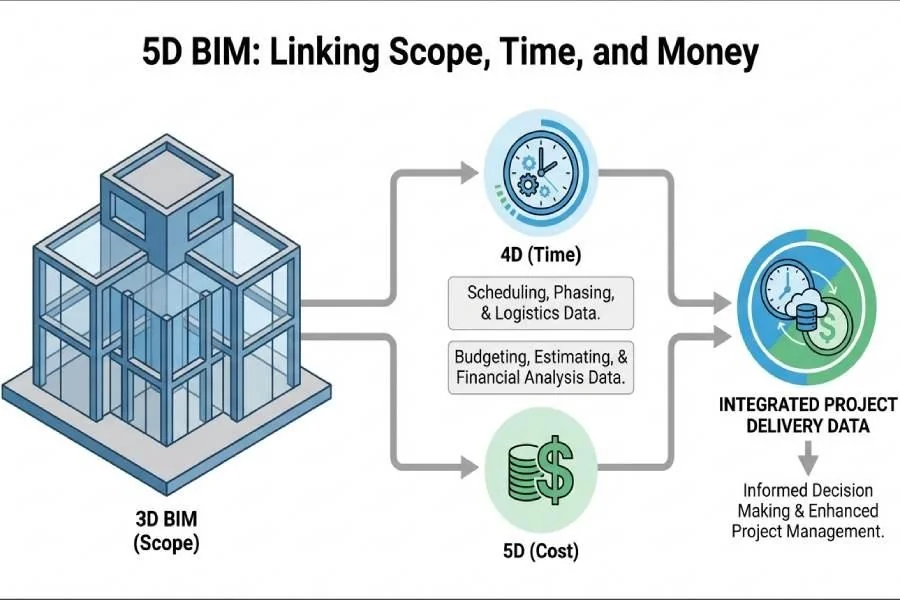
5D BIM connects model-based quantities to line-item costs and schedule logic, closing the gap between construction estimation and field reality. When design teams in engineering and architecture iterate, the estimate and the schedule auto-update, enhancing budget management and construction cost control.
Common Data Environments and collaboration tools
A Common Data Environment (CDE) such as Procore streamlines submittals, RFIs, change events, and production tracking. Integrations and APIs—covered frequently by industry voices like Hugh Seaton and demonstrated on Vimeo—feed cost estimating and project management dashboards. Organizations such as IDEAA support interoperability principles that reduce data loss and reinforce accuracy and reliability.
Digital twins and governance
- Maintain a cost-governed model baseline that links WBS/CBS codes to model elements for project planning.
- Embed cost segregation and lifecycle attributes to inform OPEX/CAPEX trade-offs.
- Track estimating standards, audit trails, and change histories for government projects and federal clients.
Simulation for sustainability
Digital twins can simulate energy challenges and environmental planning scenarios, quantifying the cost impact of envelope upgrades, on-site renewables, or mechanical alternatives—an essential capability in commercial projects seeking both cost savings and resilience.
Contracting and Procurement Strategies: IPD, Target-Cost, and Incentive Alignment
Commercial intent shapes behavior. Choosing the right commercial model is a cornerstone of construction cost management.
IPD and target value design
Integrated Project Delivery (IPD) fosters early alignment across owners, designers, and builders, enabling continuous project estimating and value engineering during preconstruction. Shared risk pools and open-book construction accounting keep teams focused on project success, project delivery, and project completion rather than siloed optimization.
Target-cost contracts and incentives
Target-cost or GMP arrangements with gainshare/painshare clauses motivate construction expertise to innovate while protecting budget management. Incentives tied to cost control, schedule adherence, and quality metrics anchor planning and execution and improve construction cost control across construction projects.
Public-sector procurement and certifications
For government projects and federal clients, compliance matters. Agencies like NAFVAC require demonstrable cost management services, audited financial management, and adherence to estimating standards. Participation in programs such as HUB (Historically Underutilized Business), WBENC (Women’s Business Enterprise National Council), and NCTRCA certifications signals a women-owned business or certified construction firm status; the Women Owned Logo often appears alongside such credentials. Firms with strong construction consulting practices may highlight affiliations with Construction Cost Management (CCM) frameworks, ASPE chapters, SAVE International, and professional recognition on LinkedIn or Inner City 100 listings to evidence credibility.
Putting it all together
When WBS/CBS/OBS structures, advanced cost estimating, and digital delivery meet incentive-aligned contracts, construction estimating services can assure project accuracy and maintain accuracy and reliability from concept through project completion. Whether the project spotlight is a courthouse renovation, a medical campus, or critical infrastructure, the right blend of construction consulting, planning resources, and dedicated resources enables teams to stay on or under budget, meet construction challenges, and achieve measurable cost savings with disciplined construction cost management.
Quantitative Risk Management and Reserves: QRA, Monte Carlo, and Risk-Adjusted Baselines
Calibrating probabilistic risk in construction projects
Quantitative Risk Assessment (QRA) elevates construction cost management by transforming qualitative threats into measurable cost and schedule exposure. Using Monte Carlo simulation early in project planning and throughout preconstruction increases accuracy and reliability by testing thousands of scenarios against the project estimation model. This approach strengthens budget management for both commercial projects and government projects, where estimating standards and auditability are paramount for project success and timely project completion.
Building a defensible risk register
- Identify cost, schedule, and performance risks across design, procurement, and construction delivery.
- Classify risks using cost segregation aligned to labor, materials, equipment, indirects, and owner soft costs.
- Quantify probability and impact with estimating metrics informed by past projects and featured projects.