
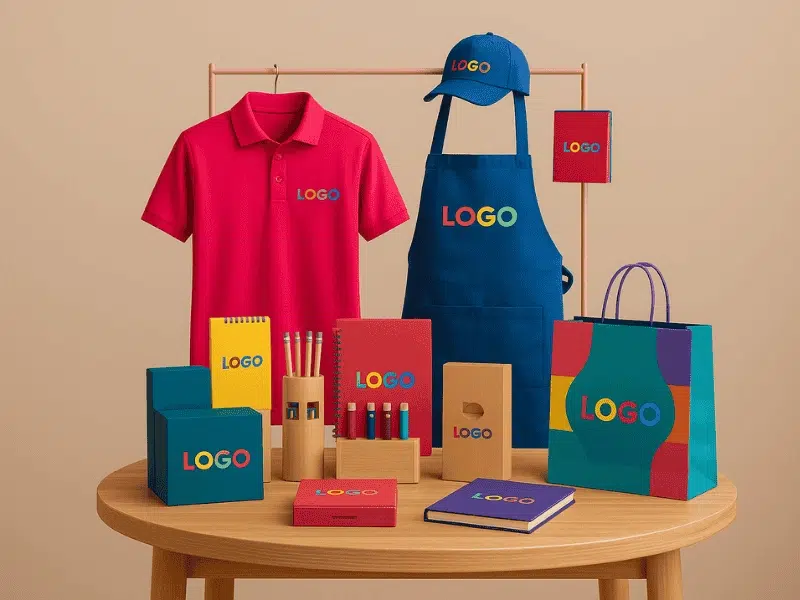
Somewhere in your building there is a box of branded stress balls from a trade show three years ago. Nobody wanted them then and nobody wants them now, but throwing them away feels like admitting something. Meanwhile the branded notebook a supplier gave your operations manager is on her desk, in use, with your competitor’s logo on it. Both were custom promotional products. Only one of them worked.
The difference was never budget. It was whether anyone thought about the recipient before opening a catalogue.
Start with the person, not the product
Most merchandise decisions run backwards: someone finds an item they like, orders it in bulk, and then works out who to give it to. Reversing that order fixes most of what goes wrong.
Ask three questions first.
Who is receiving this, specifically? A warehouse supervisor, a hospital procurement lead, and a new graduate hire want completely different things. “Our customers” is not an audience.
What do they already do every day? The items that survive are the ones that slot into an existing cybercrime— the thing they were going to carry, drink from, or write in regardless.
What do I want them to feel? Appreciated, equipped, welcomed, impressed. That answer changes the item more than any spec sheet.
Only after those three does the catalogue become useful.
The Keep-Test for Custom Promotional Products
Here is a blunt filter for any proposed item: would somebody buy this if it had no logo on it?
If yes, you are giving a gift. It will be used, it will be seen repeatedly, and your brand gets to sit alongside something the person genuinely values.
If no, you are giving an advertisement, and people throw advertisements away.
This is also the argument for fewer, better items. One well-made thing given to two hundred people who matter beats two thousand cheap things scattered across a conference floor. The cheap version does not just underperform — it actively signals what you think of the recipient, and of yourself.
Match the item to the moment
Different situations reward completely different thinking.
Trade shows and events. You are competing for attention in a loud room, and the item needs to survive a suitcase. Something genuinely useful to a traveller beats another tote destined for the hotel bin.
New hire welcome kits. This is one of the highest-return uses of merchandise, because it is the first physical evidence that joining was a good decision. Quality is noticed disproportionately here.
Client thank-yous. Small volume, high value, and the place to spend properly. A considered gift to a long-standing client is a relationship investment, not a marketing expense.
Field and safety gear. When the branded item is something people need to do their job well, it gets used every day by definition.
The unglamorous half: logistics
Sourcing is where merchandise programmes quietly fall apart, particularly at any scale.
Lead times are longer than you think. Decoration, proofing, and shipping all take real time, and overseas production adds more. Work backwards from your event date and add slack for a proof revision, because there will be one.
Multi-location distribution is its own project. Shipping to forty offices, or kitting and mailing to remote employees individually, is a fulfilment operation rather than an order.
Consolidation beats convenience. Companies that let every department buy independently end up with inconsistent branding, no negotiating leverage, and no idea what they spent. One coordinated programme usually costs less and looks better.
Ask about compliance where it matters. Anything for children, anything touching food, and anything sold into regulated markets carries requirements. Establish that before production, not after.
Measure something
Merchandise gets treated as unmeasurable, which is how weak programmes survive for years.
You can do better without much effort. Use a unique landing page or code on the item and watch traffic. Ask at the next touchpoint whether they still have it. Track redemption when merchandise is tied to a campaign. Compare booth conversations at events where you changed the giveaway. Even rough numbers beat the current standard of ordering the same thing again because nobody complained.
Conclusion
Custom promotional products work when they are chosen for a specific person, in a specific moment, at a quality that person would have paid for themselves. They fail when they are chosen from a catalogue by price. Pick fewer and better items, respect lead times, consolidate your buying, and measure something — anything — so next year’s decision is based on evidence rather than on what was left in the storeroom.