
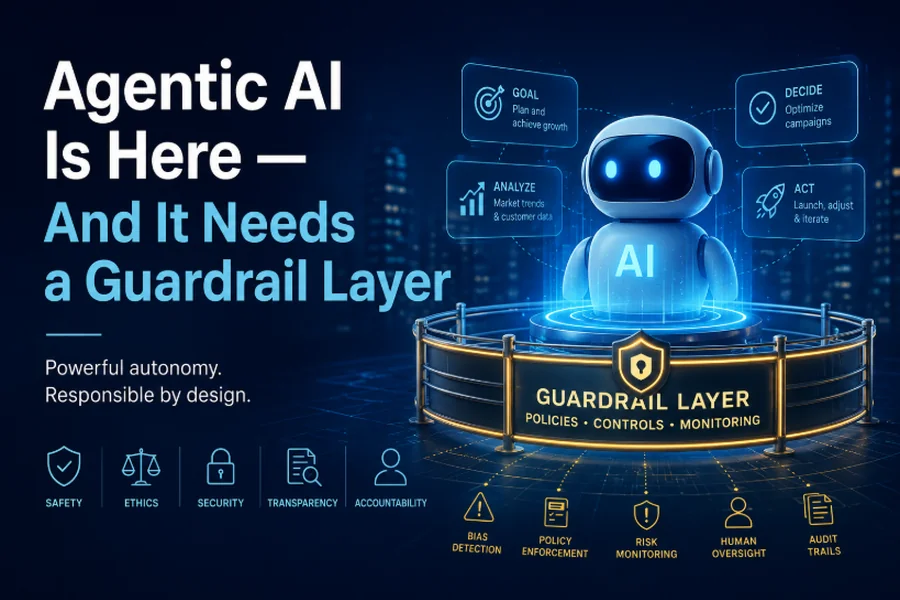
Not long ago, an AI “agent” was a chatbot that answered questions. Today, it books your meetings, writes and deploys code, negotiates with suppliers, and triggers financial transactions — all without a human in the loop.
Agentic AI is the most significant shift in enterprise technology since cloud computing. But unlike cloud migrations, the risks aren’t about uptime or latency. They’re about autonomous systems making consequential decisions at machine speed — with no pause button.
The question isn’t whether your organization will use agentic AI. It’s whether you’ll deploy it with the real-time guardrails for AI systems that it demands.
What Makes Agentic AI Different
Traditional LLM applications follow a simple request-response pattern: a user asks, a model answers. A human reads the output, decides if it’s correct, and acts accordingly. The human is always the decision-maker.
Agentic AI breaks this pattern. An agent:
- Plans and executes multi-step tasks autonomously
- Uses tools — web search, APIs, databases, code execution
- Has memory that persists across sessions
- Spawns sub-agents to delegate work
- Takes actions with real-world consequences (sending emails, writing to databases, calling external services)
This shift from “AI as assistant” to “AI as actor” changes everything about how we need to think about safety, security, and compliance.
| 📊 By the Numbers
• Gartner projects that by 2028, 33% of enterprise software will include agentic AI capabilities, up from less than 1% in 2024. • A 2025 IBM survey found 74% of enterprises deploying AI agents had experienced at least one unintended autonomous action. • The average cost of an AI-related security incident in financial services now exceeds $4.2M — before regulatory fines. |
The Unique Risks of Agentic Systems
The risks in agentic AI aren’t just bigger versions of chatbot risks. They’re qualitatively different. Here’s why standard monitoring falls dangerously short:
1. Cascading Failures Across Tool Chains
A single flawed reasoning step can propagate through an entire workflow. An agent that misreads a date field doesn’t just give a wrong answer — it may send 10,000 incorrectly dated invoices, schedule 500 wrong meetings, or trigger a cascade of downstream API calls before any human notices. Traditional error logs don’t capture semantic failures mid-chain.
2. Prompt Injection in Multi-Agent Environments
When an agent reads emails, scrapes web pages, or processes documents, any of that content can contain adversarial instructions designed to hijack its behavior. In a multi-agent system — where Agent A hands off tasks to Agent B and C — a single injected prompt can compromise the entire workflow. This is the new SQL injection, and most organizations have no defenses against it.
3. Memory and Context Manipulation
Persistent memory is what makes agents genuinely useful — they remember context across sessions. But persistent memory is also an attack surface. Malicious inputs can corrupt an agent’s long-term memory, subtly biasing future decisions in ways that are extremely difficult to detect and trace back to origin.
4. Autonomy Without Auditability
Most organizations deploying agents today cannot answer a basic question: “Why did the agent do that?” Without traceable audit trails mapping decisions to inputs, reasoning steps, and tool calls, compliance becomes impossible. Regulators under the EU AI Act, NIST AI RMF, and SOC 2 frameworks are already asking this question — and the answers are not reassuring.
Why Traditional Monitoring Doesn’t Work
Teams often reach for familiar tools when deploying agents — Datadog for infrastructure, Splunk for logs, or basic LLM output filters. These tools are excellent at what they were built for. But they were not built for this.
| Challenge | Traditional Tools | AI Guardrail Layer |
| Prompt injection detection | ❌ Not designed for it | ✅ Real-time adversarial scanning |
| Semantic drift in outputs | ❌ Log-based only | ✅ Continuous semantic monitoring |
| Multi-step reasoning audit | ❌ No visibility | ✅ Full trace per agent step |
| Compliance evidence generation | ❌ Manual effort | ✅ Automated, framework-mapped |
| Hallucination detection | ❌ No native support | ✅ Proprietary hallucination detectors |
| Policy enforcement (real-time) | ❌ Post-hoc alerting | ✅ Pre-action guardrails |
What a Guardrail Layer Actually Looks Like
A true guardrail layer for agentic AI operates at three levels: before the agent acts, while it acts, and after it acts. Here’s what each layer must cover:
Pre-Deployment: Red-Team Before You Ship
Before your agent touches production, it needs adversarial testing — automated probes that simulate prompt injection, jailbreak attempts, data exfiltration scenarios, and edge cases your team hasn’t imagined. These tests should be mapped against industry frameworks like MITRE ATLAS, OWASP LLM Top 10, and NIST AI RMF so your security posture is auditable, not anecdotal.
Runtime: Guardrails That Travel With the Agent
Every prompt in and every response out should pass through real-time guardrails for AI systems — a dedicated layer that checks for:
- Policy violations (PII exposure, scope creep, unauthorized actions)
- Semantic anomalies that suggest drift or manipulation
- Hallucinated tool calls or fabricated data references
- Cross-agent instruction conflicts in multi-agent pipelines
Critically, this can’t be a logging system that tells you what went wrong after the fact. It needs to be a pre-action interceptor that blocks or escalates before consequences are irreversible.
Post-Deployment: Observability With a Memory
Production monitoring for agentic AI must track performance degradation, model drift, anomalous behavior patterns, and compliance status in real time — with dashboards that don’t require a data scientist to interpret. When something goes wrong, the audit trail should surface in one click: which agent, which step, which input, which decision, which consequence. That’s the bar for enterprise-grade observability.
Industry Spotlight: Where Guardrails Are Not Optional
Financial Services
AI agents in finance autonomously execute trades, approve micro-loans, flag fraud, and generate regulatory reports. An agent with miscalibrated risk thresholds or a manipulated memory state isn’t just an IT problem — it’s a systemic risk event. Compliance with MiFID II, SOX, and emerging AI-specific regulations demands traceable, explainable decisions at every step.
Healthcare
Clinical AI agents that schedule procedures, triage patients, or recommend treatments operate in a zero-tolerance environment. A hallucinated drug dosage or a miscommunication between agents managing a patient record isn’t a bug — it’s a patient safety event. HIPAA compliance requires not just privacy protection but auditable evidence of every decision.
Government & Defense
Threat analysis agents, procurement automation, and policy generation systems in government contexts face adversarial environments by design. Nation-state actors actively probe AI systems for vulnerabilities. The attack surface of an agentic system — with tool access, persistent memory, and cross-agency data flows — is orders of magnitude larger than a simple query interface.
The Compliance Imperative: Regulations Are Catching Up Fast
Regulatory frameworks weren’t designed with autonomous agents in mind — but they’re adapting faster than most organizations realize. Here’s where the pressure is building:
- EU AI Act (2024-2026 rollout): High-risk AI systems require conformity assessments, human oversight mechanisms, and detailed logging. Agentic systems in regulated industries almost certainly qualify as high-risk.
- NIST AI RMF: The Govern-Map-Measure-Manage framework explicitly requires continuous monitoring and documented risk mitigation — not just at deployment, but throughout the AI lifecycle.
- SEC AI Guidance: Financial firms using AI for investment decisions face increasing scrutiny on explainability and audit trail requirements.
- HIPAA + OCR Guidance: Healthcare AI must demonstrate data integrity and access controls that extend to every tool an agent can call.
The organizations that build guardrails now will have a compliance head start. Those that wait will be scrambling to retrofit safety into systems that weren’t designed for it.
5 Steps to Deploy Agentic AI Responsibly
You don’t need to slow down your AI roadmap. You need to build the guardrail layer in parallel. Here’s a practical framework:
- Map Your Agent’s Blast Radius
Before deployment, document every tool, API, database, and system your agent can touch. Define the maximum scope of impact if the agent behaves unexpectedly. This isn’t pessimism — it’s architecture.
- Red-Team Before You Ship
Run automated adversarial tests against every agent before it sees production traffic. Prompt injection, goal hijacking, data exfiltration attempts, and boundary violations should all be tested against your specific deployment context.
- Instrument Every Decision Point
Ensure every reasoning step, tool call, and output is logged with enough fidelity to reconstruct causality. ‘The agent did something unexpected’ is not an acceptable post-incident report.
- Set Behavioral Guardrails, Not Just Content Filters
Content filters catch bad words. Behavioral guardrails catch bad actions. Implement pre-action checks that enforce scope boundaries, policy constraints, and escalation protocols for high-stakes decisions.
- Establish a Continuous Monitoring Baseline
Define what ‘normal’ looks like for your agent — performance benchmarks, typical tool usage patterns, expected output distributions. Deviations from that baseline are your early warning system.
| The Bottom Line
Agentic AI is not a future risk. It is a present-tense operational reality in organizations across finance, healthcare, logistics, and government. The gap between its capability and the safety infrastructure around it is growing every quarter. A guardrail layer isn’t a tax on innovation. It’s the foundation that makes innovation sustainable — the difference between AI that builds trust and AI that destroys it. |
About Trusys.ai
Trusys AI (Trusys.ai) is an enterprise-grade AI Assurance Platform that empowers organizations to evaluate, secure, and monitor LLM applications — from prototyping to production. Our three core modules — TRU SCOUT (adversarial security testing), TRU GUARD (real-time guardrails for AI systems), and TRU PULSE (production observability) — provide a unified control layer for responsible AI across your entire stack.