
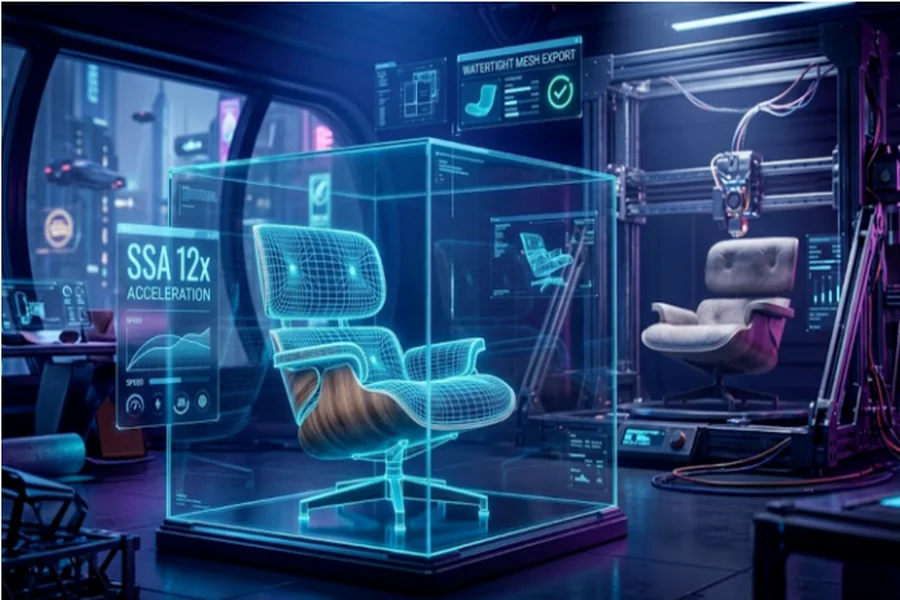
In the hyper-competitive world of modern furniture retail, the ability to offer customization is no longer a luxury. It is a survival requirement. However, the traditional furniture design cycle is plagued by high costs and long lead times. For a brand to bring a single custom armchair or modular shelving unit from concept to consumer, the process often spans months of manual 3D modeling and physical sampling. This creates a significant barrier to entry for smaller retailers and a constant drain on the ROI of industry giants. This is where the integration of a low-cost 3D prototyping AI via Neural4D is fundamentally rewriting the playbook of the retail supply chain.
Founded on industrial-grade research from global leaders like Oxford, Neural4D provides an automated engine that bridges the gap between a 2D design sketch and a production-ready 3D asset. By leveraging the Direct3D-S2 architecture, N4D allows retailers to move away from expensive manual sculpting toward a deterministic, high-fidelity digital workflow.
The Prototyping Bottleneck in Furniture Retail
Retailers today face a “customization paradox.” While consumers demand unique designs, the costs associated with physical prototyping make mass customization nearly impossible.
The Physical Sampling Trap: Every iteration of a new furniture line requires a physical sample to test ergonomics and material aesthetics. This leads to massive scrap waste and shipping delays.
Resource Scarcity: Skilled 3D modelers who understand manufacturing constraints are expensive and in high demand.
Time-to-Market Latency: A slow prototyping cycle means missing out on seasonal trends, allowing competitors to capture the market first.
The introduction of a low-cost 3D prototyping AI allows brands to generate hundreds of variations of a single design in seconds. This allows for virtual stress testing and consumer feedback loops before a single dollar is spent on raw materials or factory time.
Engineering Precision with Direct3D-S2
For the furniture industry, a “pretty picture” is not enough. The 3D model must be a blueprint for reality. Neural4D distinguishes itself by focusing on the mathematical integrity of the mesh.
Watertight for Direct Production
Many generic AI tools produce models that are essentially hollow shells. Neural4D ensures all outputs are watertight. This means the resulting model is mathematically closed and structurally sound. A designer can export an N4D asset and send it directly to a 3D printer for a scale-model prototype without manual geometry repair.
Quad-Dominant Edge Flow
Professional furniture designers require clean topology for high-end rendering and manufacturing. N4D produces quad-dominant meshes that follow the natural contours of the object. This ensures that textures like wood grain or velvet pile map perfectly across the surface without distortion.
Operational ROI via Spatial Sparse Attention (SSA)
Efficiency is the ultimate competitive moat in retail. The faster and cheaper a retailer can generate assets, the more agile they become in a shifting market.
12x Inference Acceleration
The Spatial Sparse Attention (SSA) mechanism in the Direct3D-S2 engine focuses compute power only on the active surfaces of a 3D object. This results in a 12x speed increase in generation compared to traditional voxel-based methods. This speed is critical for retail platforms that need to handle batch inference for entire seasonal collections.
Computational Cost Reduction
By reducing the computational overhead, N4D enables retailers to scale their digital asset production without investing in expensive GPU farms. This reduction in overhead directly translates to a lower total cost of ownership (TCO) for the brand’s digital infrastructure.
PBR Workflows: Bridging the Virtual and the Physical
In furniture retail, the texture is often more important than the shape. A consumer needs to see the difference between brushed brass and polished chrome, or between oak and walnut.
Pure Albedo Texturing
N4D separates lighting from color by generating pure albedo textures. This ensures that digital models maintain a consistent, realistic look regardless of the lighting conditions in a web viewer or an AR application.
Standardized Material Maps
By generating comprehensive Normal, Roughness, and Metallic maps, N4D provides a full PBR workflow. This technical depth allows retailers to replace traditional photography with photorealistic 3D renders, further reducing the costs of marketing and catalog production. The result is a unified asset that works as well for a factory blueprint as it does for a digital showroom.
Conclusion: Efficiency as a Strategic Advantage
The retail industry is moving toward a future defined by digital-first manufacturing. Neural4D is the essential infrastructure for this transition. By providing a low-cost 3D prototyping AI, the Direct3D-S2 engine allows furniture brands to innovate with zero material waste and minimal lead times. This technology does not just speed up the design process. It democratizes high-end manufacturing, allowing retailers of all sizes to compete on a global scale. In an era where agility is everything, N4D is the tool that ensures your brand stays ahead of the curve.