
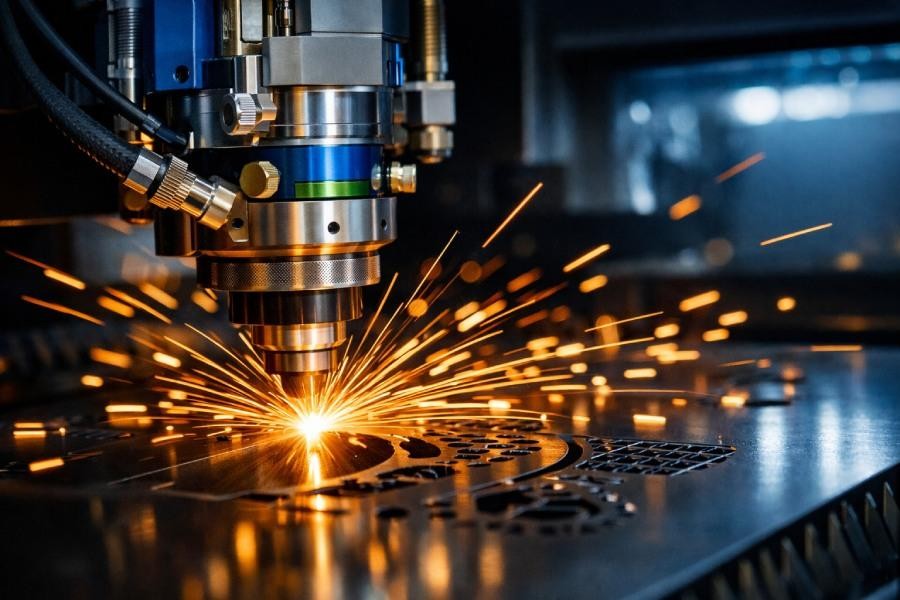
Fibre laser technology is revolutionizing metal cutting by delivering high precision, faster processing speeds, and greater energy efficiency. Using an optical fiber as the gain medium, fibre lasers produce a powerful, highly focused beam capable of cutting a wide range of metals with exceptional accuracy. As industries demand higher productivity and quality, fibre lasers are becoming the preferred solution for modern metal fabrication.
Fibre Laser Technology: The Future of Precision Metal Cutting
A fiber laser (Commonwealth English: fibre laser) has rapidly become the reference platform for precision laser cutting and high-throughput fabrication. In a fibre laser, the optical fiber itself is the active gain medium, doped with rare-earth elements to provide efficient lasing and robust, alignment-free operation. According to Wikipedia and industry benchmarks, modern systems deliver stable output power at kilowatt levels with exceptional beam quality, enabling micron-scale features across a wide range of metals. Compared with legacy gas laser platforms, the fibre laser architecture offers superior efficiency, reliability, and a dramatically lower cost of ownership.
How Fibre Lasers Work: Beam Generation, Delivery Through Fibre, and Why They Enable Micron-Level Precision
Beam generation in an all-fiber architecture
At the heart of a fibre laser is a doped fiber amplifier serving as the active gain medium. Ytterbium-, erbium-, and neodymium-doped optical fiber are the most prevalent; these rare-earth elements provide broad absorption bands and high quantum efficiency. A typical industrial design is a MOPA (master oscillator power amplifier): a low-noise master oscillator seeds one or more doped fiber amplifier stages to scale output power while preserving beam quality.
Pump energy from semiconductor laser diodes is coupled into a double-clad fiber. The diode light enters the large inner cladding as a multimode pump beam, overlapping the doped core, where stimulated emission occurs to produce lasing. The laser cavity is formed within the optical fiber, often using fiber Bragg grating structures for optical feedback in place of bulk dielectric mirrors, creating a compact, vibration-insensitive resonator. Components are permanently joined by fusion splicing, producing a monolithic optical path that is rugged on the shop floor. Functionally, the fibre laser is a diode-pumped solid-state laser realized inside an optical fiber, with outstanding power scaling potential and turn-key operation in continuous-wave regimes.
Fiber delivery to the cutting head
Because the gain and transport media are both optical fiber, power can be routed flexibly to the machine’s cutting head without free-space optics. The small, circular core supports near diffraction-limited propagation, which preserves beam quality over long runs. Integrated isolators and sensors manage back-reflections from the workpiece, while sealed fiber connectors maintain cleanliness and uptime. This all-fiber delivery, unlike a typical gas laser with external beam paths, resists misalignment and contamination.
Why micron-level precision is achievable
Micron-scale features depend on a combination of beam quality, focusability, and motion control. The fibre laser’s single-mode core produces a tight spot with high irradiance, translating to narrow kerf width and minimal heat input. Excellent thermal handling arises from the fiber’s high surface area to volume ratio, which helps extract heat uniformly and stabilizes the active gain medium. The result is a consistent, bright beam that can be focused to small spot sizes at high output power, enabling fine features and tight tolerances on thin sheets while also supporting high-speed contouring.
Performance Advantages vs. CO2 and Other Laser Types: Speed, Energy Efficiency, Reliability, and Total Cost of Ownership
Speed and energy efficiency
At roughly 1 µm wavelength (e.g., ytterbium-doped fiber), absorption in steels, aluminum, and copper alloys is higher than with a 10.6 µm CO2 gas laser, yielding faster laser cutting speeds. Wall-plug efficiency from semiconductor laser diodes into the doped fiber amplifier chain is significantly higher than legacy sources, so more of the electrical power reaches the workpiece. In continuous-wave cutting at kilowatt levels, feed rates typically exceed those of CO2 systems on thin and mid-gauge materials.
Reliability and total cost of ownership
Monolithic optical fiber paths, fusion splicing, and the absence of free-space optics reduce drift and maintenance. No cavity alignment or internal dielectric mirrors need routine attention, and sealed fiber Bragg grating reflectors maintain optical feedback without degradation. The result is high uptime, long mean time between failures, and a materially lower cost of ownership compared with many gas laser and bulk solid-state laser platforms.
Beam quality and process window
Superior beam quality and low BPP (beam parameter product) open a broad process window for both fine features and thick-plate edge quality. High brightness allows long working distances and smaller nozzles, reducing spatter and assisting-gas consumption while maintaining cut integrity.
Materials, Thickness Ranges, and Cut Quality: Handling Reflective Metals, Edge Finish, Kerf Width, Heat-Affected Zone
Reflective metals and alloys
Fiber laser sources, particularly ytterbium-based, excel on stainless steels, carbon steels, and aluminum alloys. With proper optics and process parameters, they also handle highly reflective metals such as copper and brass more effectively than CO2 platforms. Advanced heads incorporate protection for back-reflection, preserving the integrity of the doped fiber amplifier chain and the pump laser diode modules.
Edge finish, kerf, and HAZ
- Kerf width: The high-brightness, diffraction-limited beam focuses to a small spot, minimizing kerf and enabling dense nesting patterns.
- Edge quality: Nitrogen assist promotes clean, oxide-free edges; oxygen assists on mild steel maximize speed with a modest oxide layer.
- Heat-affected zone: High cutting speeds and a concentrated beam minimize HAZ, preserving mechanical properties and reducing post-processing. While optimized for laser cutting, the same platform can pivot to laser welding with appropriate optics and process gas, leveraging identical stability and beam quality.
Typical thickness ranges
Modern fibre laser systems at multi-kilowatt levels cut thin sheet at extremely high speed and can process thicker sections (e.g., >20 mm steel) with appropriate nozzles, gas strategies, and motion control. For specialty alloys or very thick plate, process windows depend on beam shaping and assist-gas optimization.
Selecting and Integrating a Fibre Laser System: Power and Beam Quality (BPP), Assist Gases, Automation, Nesting/CAM Software, Maintenance and Safety
Power and beam quality (BPP)
Match output power to your mix of thin and thick materials. Higher kilowatt levels increase throughput and piercing capability, but ensure the beam quality (BPP) supports your feature sizes. For microfeatures, prioritize near diffraction-limited performance; for heavy-plate work, consider beam shaping options that broaden the process window.
Assist gases and cutting head configuration
Use nitrogen for oxide-free stainless and aluminum, oxygen for fast mild steel, and clean dry air as a cost-effective compromise. Modern heads integrate sensors for standoff control, pierce detection, and protective windows to shield the optics and the active gain medium chain downstream.
Automation, nesting, and CAM
Invest in nesting/CAM software that minimizes scrap, selects lead-ins/outs intelligently, and tunes pierce schedules per material. Machine controllers now adjust parameters in real time based on kerf sensing and cut monitoring, improving consistency and reducing rework.
Maintenance and safety
With all-fiber cavities and fusion splicing, routine alignment is unnecessary. Maintain clean protective windows, filters, and chillers; monitor logs for early indicators of connector contamination or pump degradation.
Practical safety note
Even with enclosed machines, treat the system as a high-power laser source: verify interlocks, maintain certified eyewear for service access, and schedule periodic checks of back-reflection isolators to protect the doped fiber amplifier and pump diodes.
The Road Ahead: Beam Shaping, Ultrafast Hybrids, AI-Driven Optimization, and Sustainability in Metal Fabrication
Beam shaping and brightness management
Programmable beam shaping (e.g., ring and multi-spot modes) tailors energy deposition for faster piercing and smoother edges on thick plate. Continued power scaling in doped fiber amplifier stages faces nonlinearities particular to long optical fiber, including stimulated Raman scattering, four-wave mixing, and Kerr effect dynamics that can trigger optical soliton behavior. Materials research on rare-earth elements beyond erbium, ytterbium, and neodymium—such as dysprosium, praseodymium, thulium, and holmium—aims to expand wavelength agility and mitigate these limits while keeping the active gain medium efficient and robust.
Ultrafast hybrids and precision micromachining
Hybrid platforms pair a fibre laser engine with ultrafast pulse capability for burr-free microfeatures and minimal HAZ. Mode locking with a saturable absorber (including SESAMs—semiconductor saturable-absorber mirrors—or 2D materials like Graphene) enables picosecond to femtosecond operation. MOPA chains amplify these pulses in doped fiber amplifier stages while preserving beam quality. Such systems complement continuous-wave cutting by offering crack-resistant trepanning, precision drilling, and fine trimming on heat-sensitive alloys.
AI-driven optimization and sustainability
AI/ML models infer optimal parameters from cut signatures, adjusting focus, speed, and gas pressure on the fly to stabilize quality and reduce gas consumption. Higher wall-plug efficiency from semiconductor laser diodes, recyclable optics modules, and predictive maintenance all drive sustainability and a lower lifecycle cost of ownership. Compared with both gas laser and legacy bulk solid-state laser tools, the modern fibre laser platform delivers superior throughput per kWh, reduced consumables, and consistent quality across diverse material stacks.
Terminology and spelling
In Commonwealth English and many technical sources, “fibre laser” is the standard spelling; “fiber laser” is more common in North America. Both refer to the same architecture: an optical fiber that doubles as the transport waveguide and active gain medium, pumped by laser diode sources and configured with in-fiber optical feedback devices like the fiber Bragg grating.